

Storage is one of those home categories that seems easy to understand. Every household needs somewhere to put clothes, shoes, books, accessories, and everyday items. For retailers, this can make storage seem straightforward: find practical products, set the right price, and keep them in stock.
But after years of designing and selling home products to consumers, we at SONGMICS have found that successful storage products are rarely just about adding more space. Consumers have different living situations, habits, budgets, and expectations, and these differences can easily be overlooked when selecting products from a catalog.
That is why we look beyond what a product stores and consider how it fits into people’s lives. From that perspective, here are six common mistakes retailers can avoid when building a home storage assortment.
Assuming Open Storage Means Low-End and Closed Storage Means Premium
It is easy to create a simple hierarchy in storage furniture: open storage furniture feels basic, while closed storage furniture feels more substantial and therefore more premium. In practice, the value consumers see in a product depends on much more than whether it has doors.
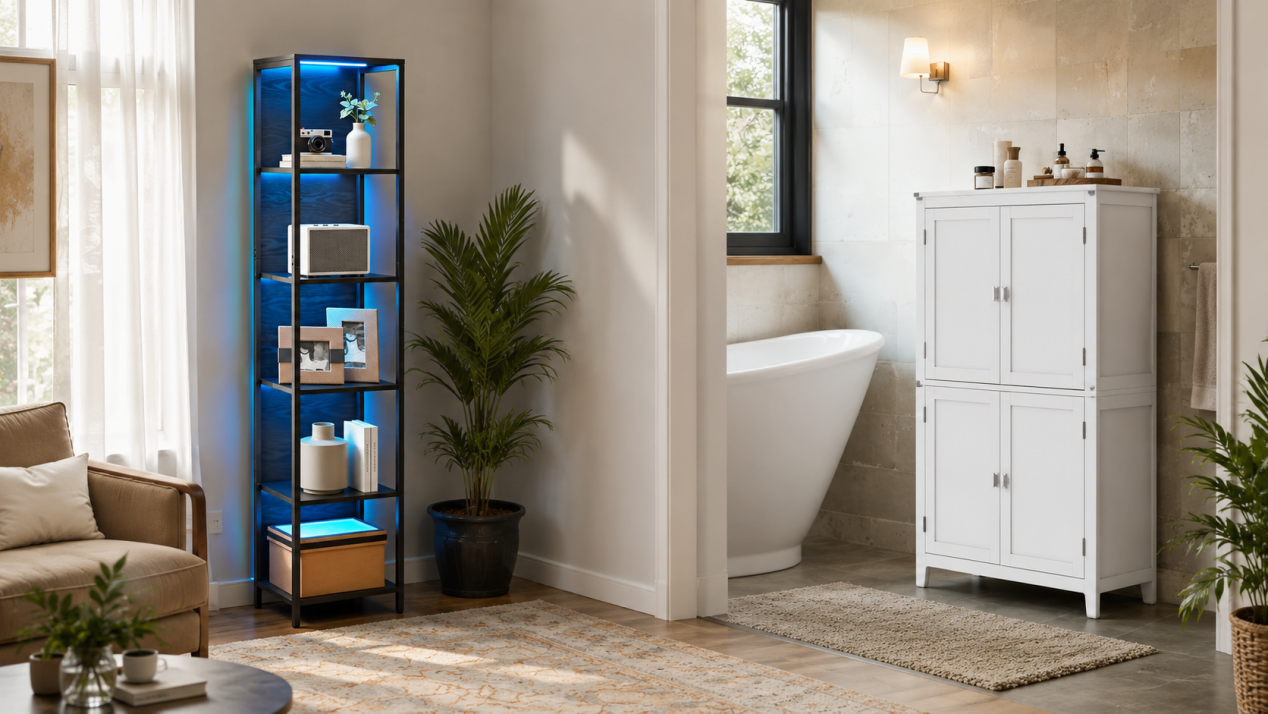
At SONGMICS, we have found that open storage can appeal to consumers because it makes everyday items accessible and allows them to display belongings as part of the room. Our Compact LED Bookshelf combines an open six-tier structure with steel, particleboard, and integrated LED lighting, turning storage into part of the room’s visual design.
Closed storage serves a different purpose. The Floor Cabinet with Adjustable Shelves provides enclosed organization while adding adjustable shelving and a furniture-like appearance. Its value comes from the combination of organization, flexibility, stability, and design—not simply from having doors.
For retailers, the more useful question is therefore not whether open or closed storage looks more premium, but whether the format, construction, materials, and design match the customer’s needs and expectations.
Treating Storage as a Seasonal Category
Storage products can seem seasonal because the items consumers organize change throughout the year. But there is an important difference between seasonal storage needs and seasonal storage demand.
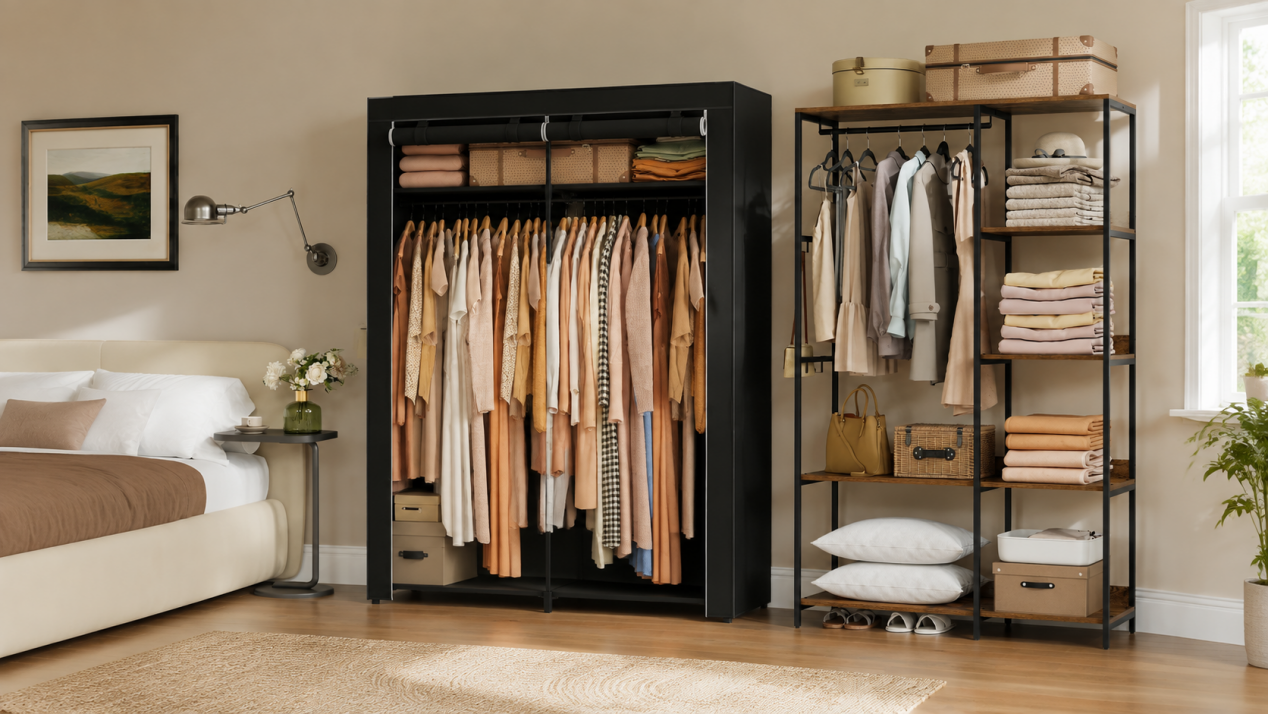
Summer may bring moving, travel, or home reorganization, while autumn and winter bring coats, sweaters, boots, and other seasonal belongings back into daily use. This is why we design products that can adapt to different scenarios. The Non-Woven Fabric Wardrobe combines two hanging rails with adjustable shelves, while its removable, tool-free design makes it suitable for changing storage needs.
For retailers, the opportunity is to build an assortment around different storage needs throughout the year, rather than treating storage as a category with one short selling season.
Overlooking Differences in Age, Lifestyle, and Living Situation
Another common mistake is assuming that one successful storage product should appeal to everyone.
Our experience at SONGMICS suggests otherwise. A young renter in a compact apartment may prioritize space efficiency and flexibility, while a family may care more about capacity and durability. Consumers who prioritize interior design may also evaluate the same product differently from those mainly looking for an affordable solution.
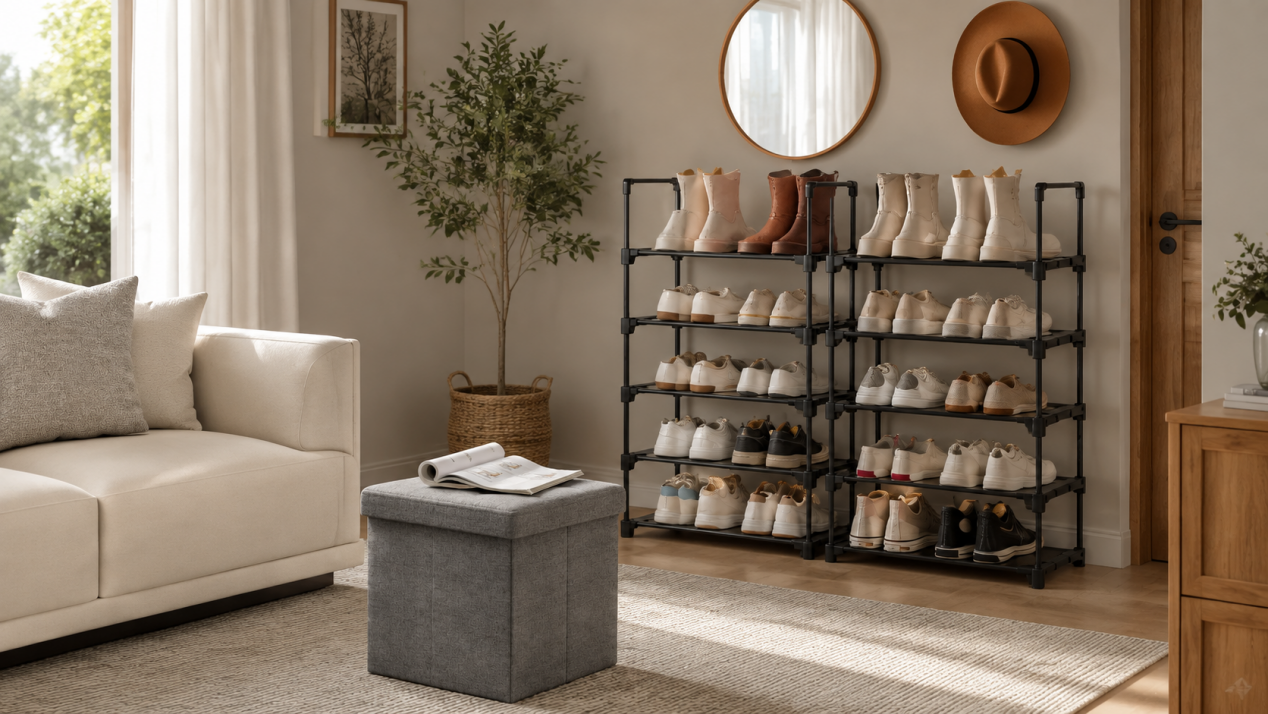
The better question is not whether to choose open storage or closed storage, but whether the design matches the value consumers are looking for. An open shoe rack, for example, can still feel practical and well-designed when it makes good use of vertical space and offers flexible configurations. A storage ottoman takes a different approach, combining concealed storage with seating and footrest functions. Both can serve different consumer needs—and both can have a place in a well-planned assortment.
This reflects a broader point: consumers do not simply buy storage capacity. They buy products that fit their space, lifestyle, aesthetic preferences, and budget.
IKEA’s 2026 Store & Organize Report, based on more than 31,000 people across 31 markets including Germany, France, Italy, Spain, the UK, the Netherlands, Sweden, and other markets, found that household organization is closely connected with how people use and experience their living spaces. For example, 82% of respondents said they keep items for sentimental reasons, while 11% of Gen Z respondents spend more than 30 minutes a day looking for a charger. These findings illustrate how storage needs can vary according to age, habits, and the way different people use their homes. [2]
For retailers, understanding these differences makes it easier to build an assortment for multiple customer groups instead of relying on one universal design.
Chasing the Lowest Price Instead of Building a Price Range
Price will always matter in retail, but making the lowest possible price the main selection criterion can limit the range of consumers a retailer can serve.
Some customers want a simple, affordable solution, while others are willing to pay more for greater capacity, flexibility, design, or multiple functions. This is why we believe a healthy storage assortment benefits from a clear price architecture.
A simple shoe rack provides a useful example. The 3-tier Sturdy Shoe Rack offers a compact storage solution, while the 10-tier Metal Shoe Rack provides greater capacity and flexibility. The two products can therefore occupy different positions within the same category rather than competing for exactly the same customer.They can play different roles within the same category:
Entry-Level SKU → Core SKU → Feature-Rich SKU → Higher-Value SKU
This kind of structure allows retailers to attract price-sensitive shoppers while also giving other customers a reason to trade up. It also reduces the risk of building an entire category around a single low-price position.
From our perspective, the goal is not to make every product inexpensive. It is to make sure each price point gives consumers a clear reason to buy.
Looking Only at Product Price and Forgetting Logistics
When a product is still in a catalog, its purchase price may look like the most important number.Once it starts moving through the supply chain, however, other numbers become important too.
For larger furniture, packaging volume, warehouse space, transportation efficiency, handling, assembly, and potential returns can all affect the real economics of a product. This is one reason packaging and assembly are important considerations in our product development.
The Non-Woven Fabric Wardrobe is a useful example. Its assembled dimensions are 140 × 43 × 174 cm, while its package measures 69 × 37 × 12.5 cm, with a package volume of approximately 0.032 m³. The product also uses tool-free assembly. The Open Wardrobe demonstrates the same principle in a larger furniture format. Its assembled dimensions are approximately 98.1 × 40 × 180.4 cm, while its package measures 110 × 47.8 × 18.3 cm, with a package volume of approximately 0.096 m³.
For us, this is not simply a packaging detail. It is part of the product itself.A well-designed flat-pack structure can help make a large piece of furniture easier to transport and store, while straightforward assembly can make the final purchase experience easier for consumers.
That is why, when evaluating larger storage furniture, retailers may want to look beyond the initial quotation and consider the complete journey:
Product → Packaging → Transportation → Warehousing → Assembly → Consumer
A product that performs well across this journey can be more commercially attractive than one that looks cheaper at the purchasing stage but creates additional costs later.
Selling Individual Storage Products Instead of Complete Solutions
The final mistake is perhaps the easiest to overlook: treating every storage product as an independent SKU.
Consumers do not usually think about their homes in terms of SKU numbers. They think about spaces and problems.Someone organizing an entryway may need somewhere for shoes, coats, bags, and accessories. Someone reorganizing a bedroom may need clothing storage, hanging space, and somewhere to put smaller items. Once we look at storage from this perspective, the opportunity becomes much larger than selling one product at a time.
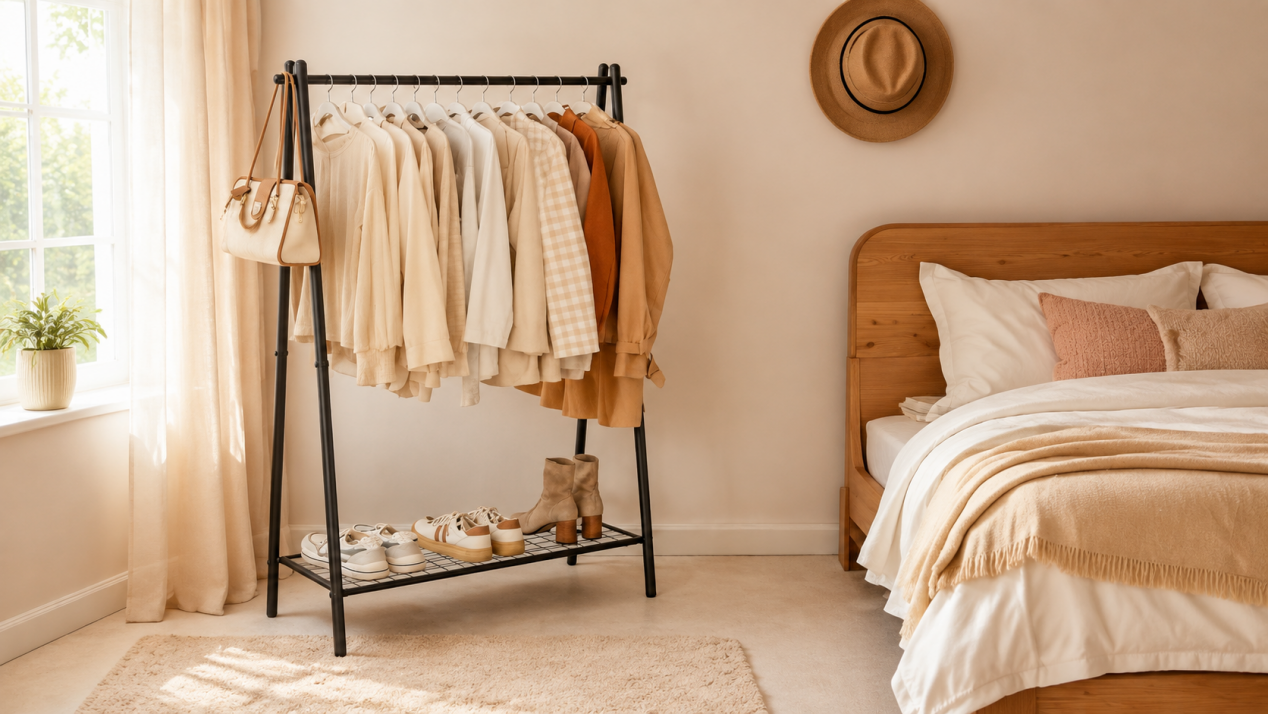
SONGMICS products can naturally be combined around these everyday scenarios.For example, the 10-tier Metal Shoe Rack can provide dedicated shoe storage, while the Steel Clothes Rack adds hanging space and a lower shelf for shoes or boxes.
The same thinking can be applied to other spaces. A wardrobe can be paired with shoe storage; a storage ottoman can complement living-room furniture; open shelving can be combined with boxes or baskets to create different levels of visible and concealed organization.
This changes the retail question from: “How many units can I sell of this SKU?” to:“What else does this customer need to organize this space?” That shift can create opportunities for cross-selling and higher basket value while also making the assortment easier for consumers to understand.
From SONGMICS’ perspective, this is an important part of product development as well. We don’t see storage products only as individual items. We look at how they can fit into the wider ways people live, organize, and furnish their homes.
What These Six Lessons Mean for Retailers
Looking across these six areas, successful storage assortment planning is less about finding a single “perfect” product and more about understanding the different reasons consumers buy storage.
Consumers may have very different priorities. Those living in smaller apartments may need to make the most of limited space, while others may prefer to keep their belongings hidden away. Some shoppers may prioritize affordability, while others are willing to pay more for flexibility or design. Seasonal changes can alter what people need to organize, while logistics and packaging can influence how attractive a product is from the retailer’s side.
This is where SONGMICS’ consumer-market experience provides a useful perspective. Our approach is shaped not only by product development, but also by observing how products perform with real consumers. The feedback loop is closer to:
Product → Consumer → Purchase → Review → Feedback → Improvement
Over time, those signals help us understand not only whether consumers buy a product, but why they choose it, how they use it, and what they expect from the next product they buy.
For B2B buyers, this experience can be useful when building an assortment. Instead of viewing a supplier’s catalog as a list of disconnected products, retailers can look for evidence that the products are designed around recognizable consumer needs—and consider how those products can work together.
That is one of the lessons we have learned from SONGMICS’ consumer-market experience: Good product selection starts with understanding the consumer problem, then working backward to the right product, price, format, and assortment.
Conclusion: Build the Right Storage Assortment, Not Just a Bigger One
Home storage is not simply about adding more shelves, cabinets, or racks to a catalog. The stronger opportunity lies in understanding the people who will eventually use them.
An open storage shelf can be just as design-led as a closed cabinet. Storage demand can remain relevant throughout the year even as use cases change. Different customers may want different combinations of capacity, style, functionality, and price. And for larger furniture, packaging and assembly can matter almost as much to the business as the product itself.
Most importantly, storage products do not have to be sold in isolation. When retailers connect complementary products around real living spaces, they can move from selling individual SKUs to offering more complete organization solutions.
That is perhaps the most useful lesson from SONGMICS: the best storage products are not simply the ones that store the most. They are the ones that solve a problem consumers recognize, in a way that makes sense for both the customer and the retailer.
Looking for More Home Storage Solutions
SONGMICS is a core home-furnishing brand under SONGMICS HOME. Founded in 2012, the brand has served more than 20 million households and follows a brand philosophy built around quality, design, and value. Its product offering covers a wide range of practical home solutions, including whole-home storage such as wardrobes, shoe racks, and storage cabinets, as well as home décor products such as shelving and hanging solutions.
For retailers, distributors, and other B2B buyers looking for a broader home-furnishing assortment, you can explore the SONGMICS HOME B2B product range to discover more solutions for different living spaces and customer needs.
If you have a bulk-ordering requirement or would like to discuss potential cooperation, contact the SONGMICS HOME B2B team to continue the conversation.
References
- The Harris Poll UK (2025).From Clutter to Clarity: Why Spring Cleaning Still Resonates for Time-Poor Consumers.
https://www.theharrispoll.co.uk/insights/blog/from-clutter-to-clarity-why-spring-cleaning-still-resonates-for-time-poor-consumers
[2] IKEA (2026).Store & Organize Report. The study surveyed more than 31,000 people across 31 markets.
https://www.ikea.com/us/en/newsroom/range-news/new-global-ikea-study-nearly-4-in-10-are-staging-a-silent-protest-over-household-mess-pubb123fe10/


