

Every September, Europe’s back-to-school season brings another wave of students into dormitories, shared apartments, and rental rooms. For retailers, distributors, and student-housing buyers, August is therefore an important stocking period: new students are furnishing rooms from scratch, while returning students often move, replace furniture, or rethink how to use limited space.
On move-in day, several problems appear immediately. There may be nowhere to sit while changing shoes, no room for an extra chair, and no proper place for spare bedding, seasonal clothes, books, or everyday clutter. Adding a chair and a separate storage cabinet solves the problems—but also consumes more floor space.
A storage ottoman provides a simpler answer: one compact piece of furniture that works as both seating and storage. For small student rooms, that combination makes it especially relevant during back-to-school and moving seasons, while giving B2B buyers a category that can serve several room functions without requiring multiple products.
This small-space pressure is visible in broader European housing data. Eurostat reports that 26.5% of EU young people aged 15–29 lived in overcrowded dwellings in 2024, compared with 16.9% of the overall population. [1] In the same year, 32% of the EU population lived in rented housing, with the share reaching 53% in Germany. [2] For buyers serving students and young renters, multi-functional furniture therefore responds to a measurable space and housing constraint, not only a seasonal trend.
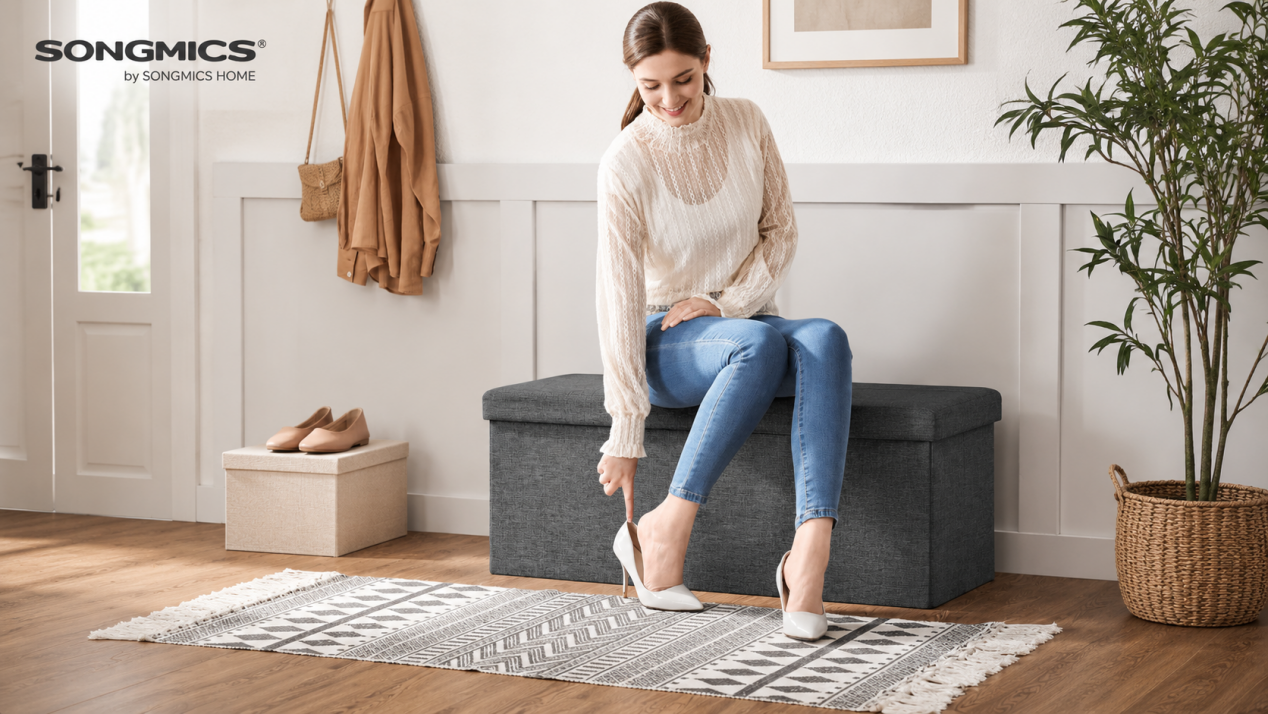
One Seat, Endless Uses
Two Functions Without Using Twice the Space
The biggest advantage of a storage ottoman is not any single feature. It is the ability to solve several small-space problems at the same time.
Placed near the entrance, it becomes a seat for putting on shoes while keeping small belongings out of sight. Beside a bed, it can provide occasional seating while storing blankets, clothes, or books. In a shared living area, it can work as a footrest, an extra seat, or even a temporary surface for lightweight everyday items.
For a student room, this is more practical than adding a separate chair and storage box. The same floor area performs more than one function.
That matters when a bedroom may also need to serve as a study space, dressing area, storage zone, and social space. Furniture that performs only one role can quickly make the room feel crowded.
A storage ottoman instead supports the small-space principle of using less furniture more effectively.
The two-in-one function also creates a stronger value proposition at the point of purchase. From the consumer’s perspective, paying for one piece of furniture that provides both seating and storage can feel more worthwhile than purchasing two separate products to achieve the same functions. For retailers, this multifunctional positioning can support a higher perceived value and create room for a higher price point than a basic storage box or simple stool alone. The product is therefore not simply competing on storage capacity or seating function, but on how many everyday needs it can satisfy within one footprint.
Useful Beyond the First Semester
The same flexibility also helps when students move.
A storage ottoman that starts as an entryway seat in one apartment may become a bedside stool in the next. If the user later moves into a larger room, it can still work as a footrest or secondary storage unit rather than becoming unnecessary furniture.
For consumers, this extends the useful life of the product. For retailers, it also broadens the selling message beyond “student storage” to include entryway seating, bedroom organization, living-room footrests, and occasional seating.
That versatility makes the category especially suitable for back-to-school assortments because buyers are not dependent on a single use case.
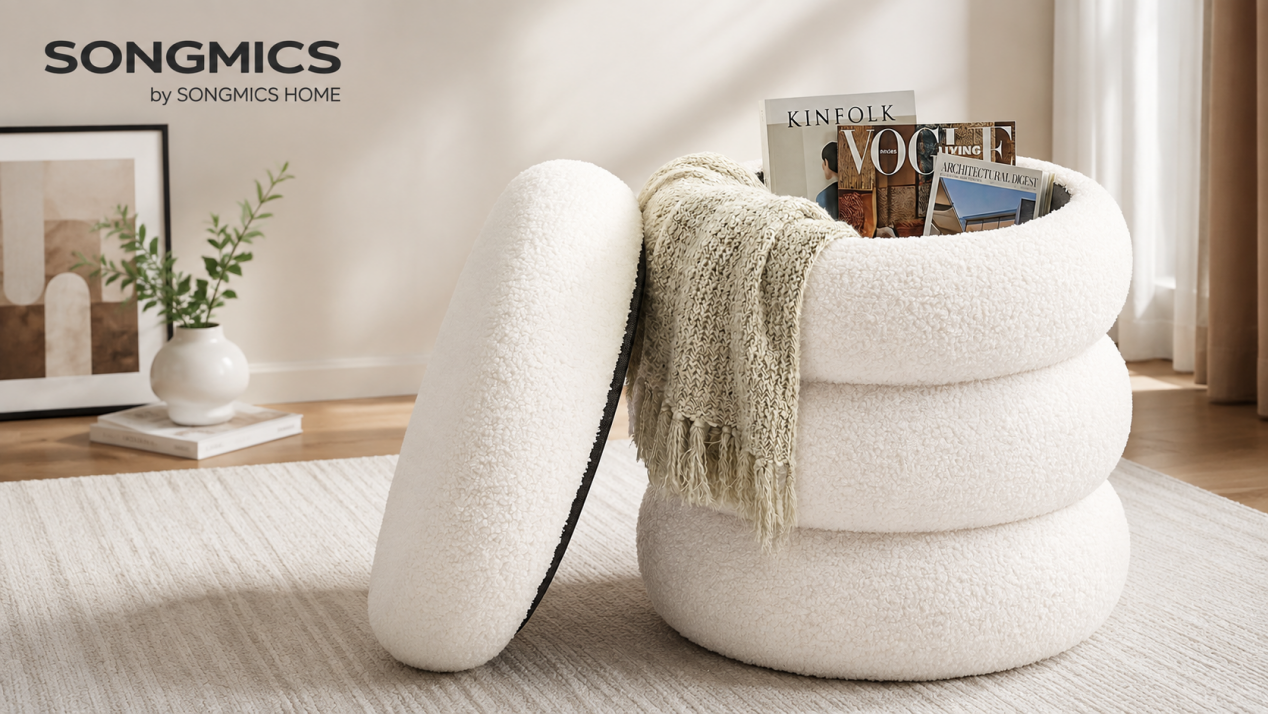
A Shape for Every Room Layout
Different student rooms require different furniture footprints. Rather than treating all storage ottomans as the same product, retailers can use shape and capacity to guide consumers toward the right option.
Rectangular: More Storage Along a Wall or Bed
A rectangular storage bench is the strongest option when capacity matters most.
A large rectangular storage ottoman bench measuring approximately 76 × 38 × 38 cm provides around 89 L of storage while also functioning as a bench.
Its longer footprint makes it particularly suitable at the end of a bed, along an entryway wall, or beneath a window. Students can use the internal space for bedding, seasonal clothes, shoes, books, or other items that would otherwise require a separate storage unit.
The padded top also allows the product to serve as an occasional seat. With a stated maximum static load of up to 300 kg, the capacity can be communicated with a clear numerical specification rather than simply describing the bench as “strong.”
For consumers, the rectangular format is therefore mainly about:
more hidden storage + usable seating + efficient use of wall or bed-end space.
Square: Compact Enough for Corners and Desks
Not every student room has enough space for a long bench.
A compact square storage ottoman offers a smaller footprint of approximately 38 × 38 cm with around 37 L of internal storage.
This format can fit beside a bed, near a desk, or in a room corner without dominating the floor plan. It can function as a footrest, temporary seat, small side table, or storage box for books, magazines, clothing, and other everyday items.
Its stated static load also reaches up to 300 kg, while the raised wooden feet keep the body slightly off the floor.
For small dormitories, this shape is especially easy to understand:
when there is no room for a bench, use a compact ottoman that can move between several roles.
Round Upholstered: Storage with a Softer Look
Some consumers want small-space furniture to provide more than practical storage.
A round upholstered storage stool combines approximately 30 L of hidden storage with a soft upholstered seat and a rounded silhouette.
At around 43 × 43 × 47 cm, it works well as a dressing stool, bedside seat, footstool, or decorative accent in a bedroom. The thick padded top and softer visual design make it especially suitable for consumers who want functional storage without making the room look overly utilitarian.
Its stated maximum static load is approximately 150 kg, while adjustable feet help provide stability on different floor surfaces.
This gives retailers a third positioning direction:
not maximum capacity, but a balance of seating comfort, hidden storage, and decorative appeal.
Together, the three shapes create a simple assortment logic:
- Rectangular: prioritize capacity.
- Square: prioritize compactness.
- Round upholstered: prioritize comfort and appearance.
Different shapes suit different layouts, but all three follow the same product principle: save space by combining storage and seating in one piece of furniture.
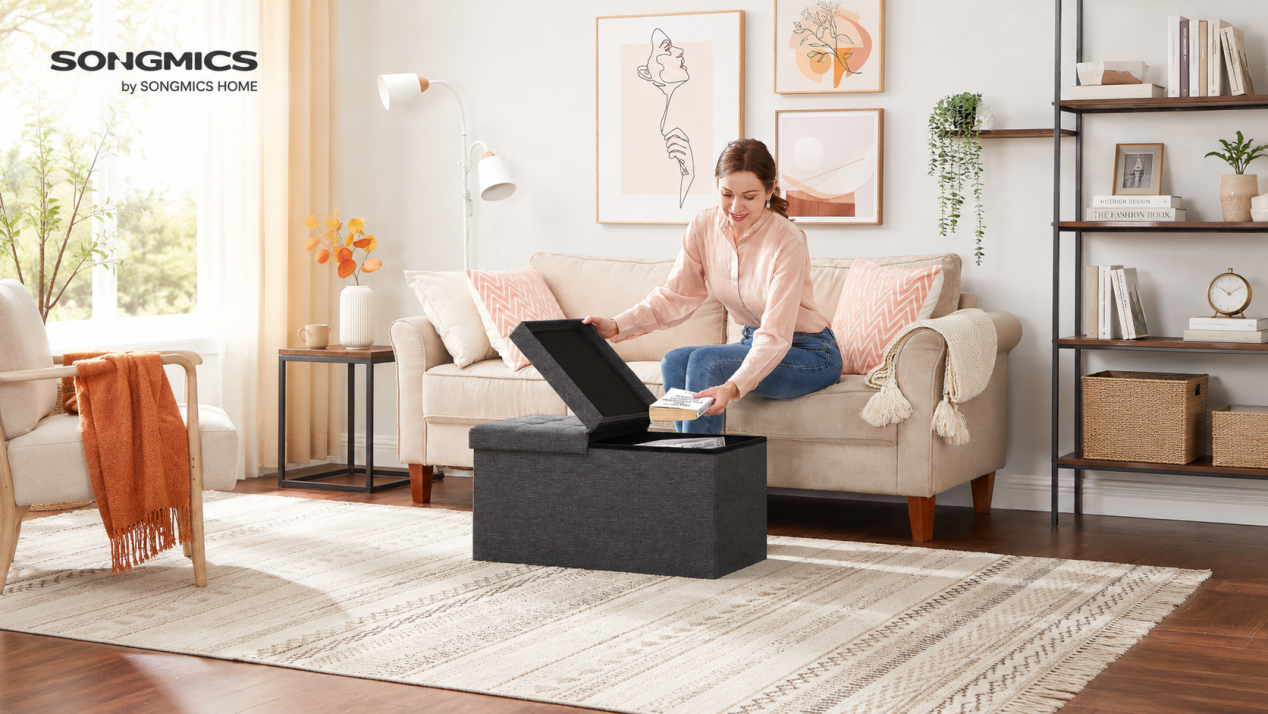
Built to Handle Daily Dorm Life
Easy Setup Matters on Move-In Day
Student furniture needs to fit a lifestyle that often involves self-assembly and frequent moves.
A freshman arriving at a dormitory may be assembling several pieces of furniture on the same day. Products that require complicated tools or lengthy installation add unnecessary friction.
Foldable rectangular and square storage ottomans simplify this process. Their bodies can be opened into shape, fitted with the base or lid, and prepared for use without the type of assembly required by a conventional cabinet or bench.
The round upholstered model follows a different structure but also minimizes setup, with most of the stool already assembled and only the feet requiring installation.
For students, easy setup means the product can begin solving storage problems almost immediately after moving in.
Foldable Designs Support Frequent Moves
The same construction becomes valuable again when the semester ends or the tenant changes accommodation.
Foldable models can be collapsed when they are not required, making them easier to store or transport than rigid furniture of a similar assembled size.
This reflects the same logic that makes storage ottomans useful in the first place: furniture should adapt to the room rather than permanently occupy it.
For students who may change dormitories, return home during holidays, or move between rental properties, that adaptability can be more important than owning a larger, permanent storage unit.
Clear Load Ratings Build Confidence
Daily dorm life also requires furniture that can handle repeated use.
The rectangular and square products discussed above provide stated static load capacities of up to 300 kg, while the round upholstered stool is rated up to approximately 150 kg.
For consumers, these figures offer reassurance when the ottoman is used as occasional seating.
For B2B buyers, numerical load ratings are even more useful. A clear specification such as “up to 300 kg” is easier to communicate through retail listings, sales materials, and distributor catalogs than vague claims such as “strong” or “durable.”
It also gives procurement teams a more objective point of comparison when evaluating different products.
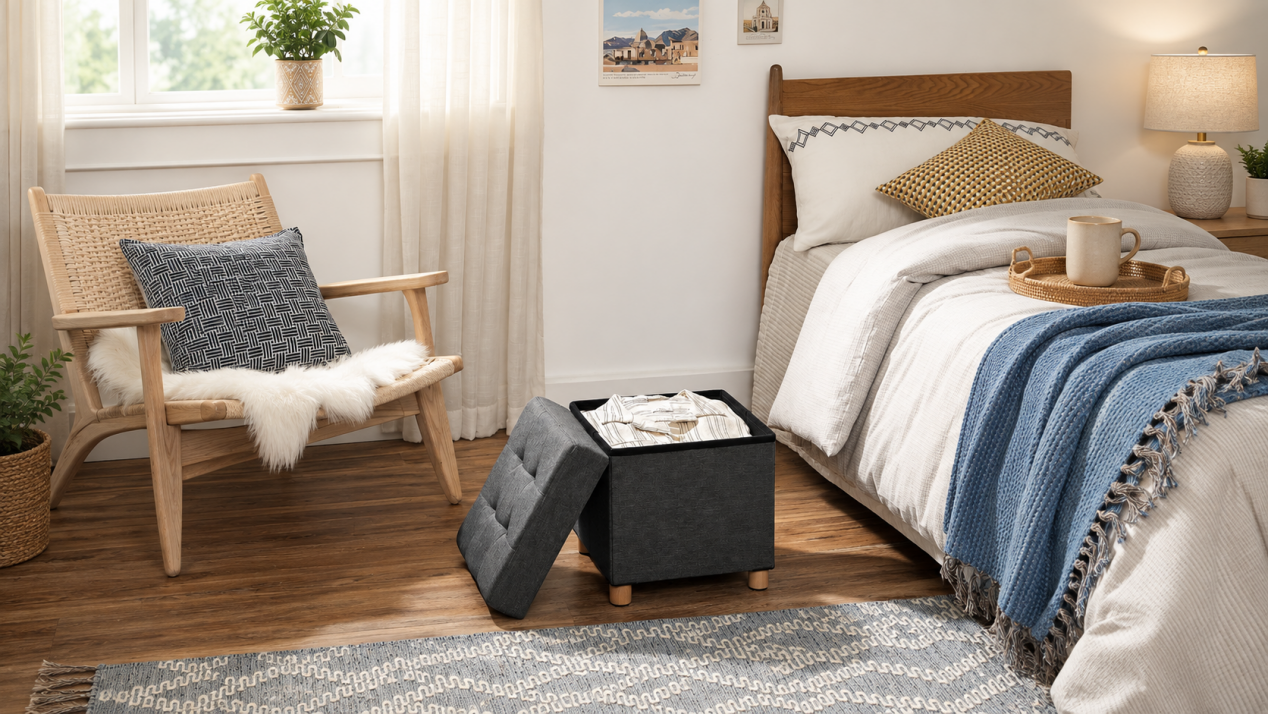
What Storage Ottomans Mean for B2B Buyers
For retailers, distributors, wholesalers, and student-housing suppliers, the commercial value of storage ottomans goes beyond the individual product. Buyers planning a broader assortment can start with the storage ottoman collection and then segment by capacity, footprint, upholstery, and price positioning for different student-room needs.
Because one ottoman can serve as an entryway shoe bench, bedroom storage unit, footrest, bedside stool, or occasional seat, the category is naturally suited to cross-selling.
During back-to-school season, for example, retailers can combine:
desk + shoe rack + storage ottoman
into a “student room essentials” assortment. Instead of selling another isolated storage product, the ottoman can complement products consumers are already purchasing when moving into new accommodation, helping increase basket value.
Different shapes also allow buyers to cover multiple price points and consumer preferences without changing the core product concept. Rectangular models can target customers who prioritize storage capacity, square models can serve smaller rooms and entry-level budgets, while upholstered round models can address consumers seeking a more decorative upgrade.
Where a product family offers additional colors or dimensions, buyers can further adapt the assortment to local interior preferences without developing an entirely new category.
Logistics are another advantage, particularly for foldable models. Although rectangular and square ottomans occupy noticeable space once assembled, their foldable structures allow them to ship in a much flatter format. This can improve carton efficiency, warehouse storage, and container utilization compared with rigid furniture of the same assembled volume.
The round upholstered model uses a different construction and should not be treated as a fully foldable product, but its limited assembly requirements still support relatively straightforward distribution and final setup.
For back-to-school and moving-season procurement, this combination is commercially useful:
multi-purpose use + clear load specifications + multiple formats + logistics-friendly foldable models.
Storage ottomans are not high-frequency consumables purchased repeatedly by the same student. However, new student cohorts, frequent moves, rental turnover, and changing room layouts create recurring replenishment demand for retailers and project buyers every academic year. Student mobility is also a meaningful part of the European education landscape: Erasmus+ reported 1.3 million learning mobility opportunities abroad in 2023. [3]
For B2B home-furnishing buyers preparing for Europe’s September back-to-school season, the strongest value of the category is therefore simple: it allows one compact product to solve several everyday problems while giving retailers multiple ways to merchandise, bundle, and position the same furniture concept.
Whether rectangular, square, or round, the core benefit remains the same:
more function from less space.
Buyers planning a broader student-room assortment can continue exploring SONGMICS HOME B2B, or Contact SONGMICS HOME to discuss wholesale, distribution, and project requirements at b2b@songmicshome.com.
References
[1] Eurostat. “Young people – housing conditions.” 2024 data: 26.5% of EU young people aged 15-29 lived in overcrowded dwellings, compared with 16.9% of the overall population. Source: https://ec.europa.eu/eurostat/statistics-explained/index.php?title=Young_people_-_housing_conditions
[2] Eurostat. “Housing in Europe – 2025 edition.” 2024 data: 32% of the EU population lived in rented housing; in Germany, 53% were tenants. Source: https://ec.europa.eu/eurostat/web/interactive-publications/housing-2025
[3] Erasmus+ / European Commission. “Erasmus+ supported 1.3 million opportunities abroad in 2023,” published 27 November 2024. Source: https://erasmus-plus.ec.europa.eu/whats-new/news/erasmus-supported-13-million-opportunities-abroad-in-2023


